


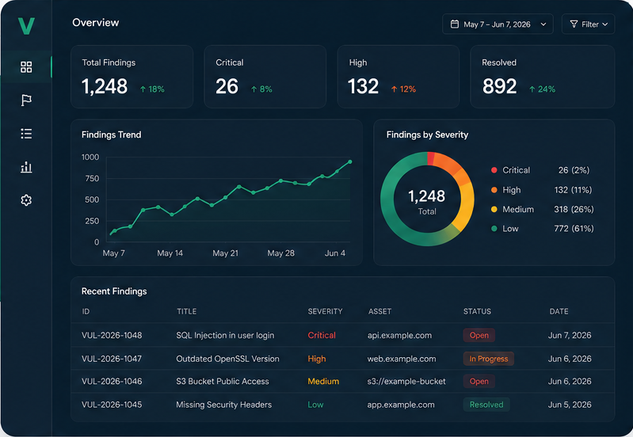
Every finding, tracked to a verified fix
Vulnury brings security findings, remediation owners, progress, and retesting into one live workflow from discovery to verified closure.
Request a DemoSee How It WorksEvery finding, tracked to a verified fix
Vulnury brings security findings, remediation owners, progress, and retesting into one live workflow from discovery to verified closure.
Security findings shouldn't end in a report

A penetration test or vulnerability assessment may identify the risk, but managing what happens next is often much harder.

Vulnury brings the remediation process into one clear, trackable workflow.
Security findings shouldn't end in a report
A penetration test or vulnerability assessment may identify the risk, but managing what happens next is often much harder.
Vulnury brings the remediation process into one clear, trackable workflow.
Find, Track, Resolve
Every finding, whether from a manual pentest, an automated scan, or a configuration review moves through the same three stages until it's verified closed.

01 Find
Discover and centralize
Findings enter Vulnury the moment they're identified, no matter the source.
Pentest, scan, and config-review results land in one repository.
Each finding is scoped: issue, affected asset, severity.
Nothing waits for the next static report.

02 Track
Assign and monitor
Every finding gets an owner, a due date, and a visible status.
Ownership routed to the responsible team or individual.
Priority set by severity and business impact.
Progress visible to security and executives at the same time.

03 Resolve
Fix and verify
Once remediation is completed, the fix can be retested and validated before the finding is officially closed.
The responsible team applies the fix.
A retest should done before marking it resolved.
Still open? It stays in the workflow, not a forgotten inbox.
Find, Track, Resolve
Every finding, whether from a manual pentest, an automated scan, or a configuration review moves through the same three stages until it's verified closed.
01 Find
Discover and centralize
Findings enter Vulnury the moment they're identified, no matter the source.
Pentest, scan, and config-review results land in one repository.
Each finding is scoped: issue, affected asset, severity.
Nothing waits for the next static report.
02 Track
Assign and monitor
Every finding gets an owner, a due date, and a visible status.
Ownership routed to the responsible team or individual.
Priority set by severity and business impact.
Progress visible to security and executives at the same time.
03 Resolve
Fix and verify
Once remediation is completed, the fix can be retested and validated before the finding is officially closed.
The responsible team applies the fix.
A retest should done before marking it resolved.
Still open? It stays in the workflow, not a forgotten inbox.
Everything a finding needs, in one place
Vulnury brings every piece of the remediation puzzle together so nothing slips through the cracks.

Vulnerability tracking
Centralized tracking of validated findings from pentests, scans, and config reviews nothing gets lost between discovery and fix.

Finding repository
A searchable record of every finding, affected asset, severity, and remediation detail, not a folder of old reports.

Remediation management
Status, owners, due dates, and priorities in one view, everyone knows who owns a fix, and when it's due.

Retesting outcomes
Captures retest results and confirms whether a vulnerability is actually closed.

Status dashboard
Open, closed, overdue, and high-priority vulnerabilities at a glance, a current answer to "where do we stand?"

Severity classification
Findings organized by criticality and business impact, so teams fix what matters most first.

Ownership assignment
Vulnerabilities routed to the responsible team or individual, removing the dilemma of "someone should fix this."

Reporting
Status, remediation-progress, and closure reports generated from live data.

Historical tracking
A record of findings, remediation actions, and retests across engagements, so improvement is visible, not assumed.
Everything a finding needs, in one place
Vulnury brings every piece of the remediation puzzle together so nothing slips through the cracks.
Vulnerability tracking
Centralized tracking of validated findings from pentests, scans, and config reviews nothing gets lost between discovery and fix.
Finding repository
A searchable record of every finding, affected asset, severity, and remediation detail, not a folder of old reports.
Remediation management
Status, owners, due dates, and priorities in one view, everyone knows who owns a fix, and when it's due.
Retesting outcomes
Captures retest results and confirms whether a vulnerability is actually closed.
Status dashboard
Open, closed, overdue, and high-priority vulnerabilities at a glance, a current answer to "where do we stand?"
Severity classification
Findings organized by criticality and business impact, so teams fix what matters most first.
Ownership assignment
Vulnerabilities routed to the responsible team or individual, removing the dilemma of "someone should fix this."
Reporting
Status, remediation-progress, and closure reports generated from live data.
Historical tracking
A record of findings, remediation actions, and retests across engagements, so improvement is visible, not assumed.

One live system, not another static report
Findings from pentests, scans, and config reviews live in one platform one continuously updated view of your remediation activity.
Accountability, built into every finding
Every vulnerability has clear ownership, priority, status, and progress, so responsibility doesn't disappear into email threads.
Closure you can actually validate
A finding doesn't simply move to “closed.” Retesting confirms whether remediation worked and records the outcome.
Built around the way your teams work
Vulnury is designed to adapt to different remediation workflows and organizational requirements without adding unnecessary complexity.
One live system, not another static report
Findings from pentests, scans, and config reviews live in one platform one continuously updated view of your remediation activity.
Accountability, built into every finding
Every vulnerability has clear ownership, priority, status, and progress, so responsibility doesn't disappear into email threads.
Closure you can actually validate
A finding doesn't simply move to “closed.” Retesting confirms whether remediation worked and records the outcome.
Built around the way your teams work
Vulnury is designed to adapt to different remediation workflows and organizational requirements without adding unnecessary complexity.
See Vulnury on your own findings
Tell us a bit about your environment and we'll walk you through how Vulnury tracks findings from first scan to final close.
See Vulnury on your own findings
Tell us a bit about your environment and we'll walk you through how Vulnury tracks findings from first scan to final close.